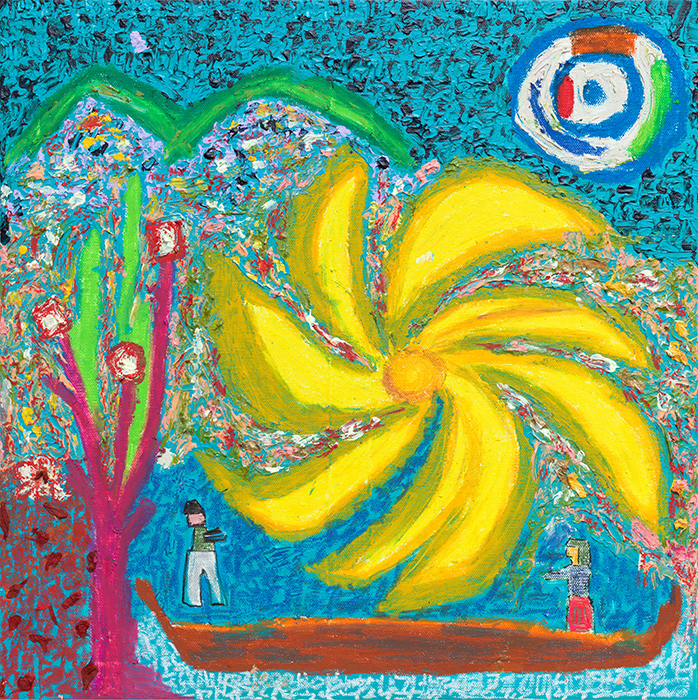
그림일기1.
45x45cm,캔버스에 아크릴,2023

The first novel I ever read, hoping it
would never end, was Milan Kundera's "The Unbearable Lightness of
Being." Even in the midst of a life filled with lament and
self-deprecation, Kundera's humor, which always flashed like a blade, had the
power to make even the most un-laughable situations seem laughable. Kundera's
skill in subtly exposing the despicable nature of humans, which had never been
properly denounced despite being a common way of living, was truly remarkable.
But that wasn’t all. Kundera's novels, which became more piercing and painful
the more I read them, yet paradoxically gave me a sense of relief, helped me
endure the gloomy 1980s. His characters, who are connected to the mundane and
trivial aspects of life, even in extreme moments, strangely put my mind at
ease.
Just as Milan Kundera, who loved the concrete, everyday, and physical aspects
of life, couldn't help but write novels instead of poetry, I too couldn't
resist the prose of life that couldn't be filled with poetry alone. The
appearance of humans, endlessly intertwining and revealing themselves within
the world, is so strange and absurd that it cannot be summarized or explained
in a single sentence. Therefore, a novel with a freer form seemed more
appropriate to reveal this.
Milan Kundera said that the reason for the existence of a novel is to show life
as it is, helping us to understand the inevitable failures of human life. In
this painting, I tried to capture Kundera's message: instead of struggling to
find answers in a life that offers none, just live it.