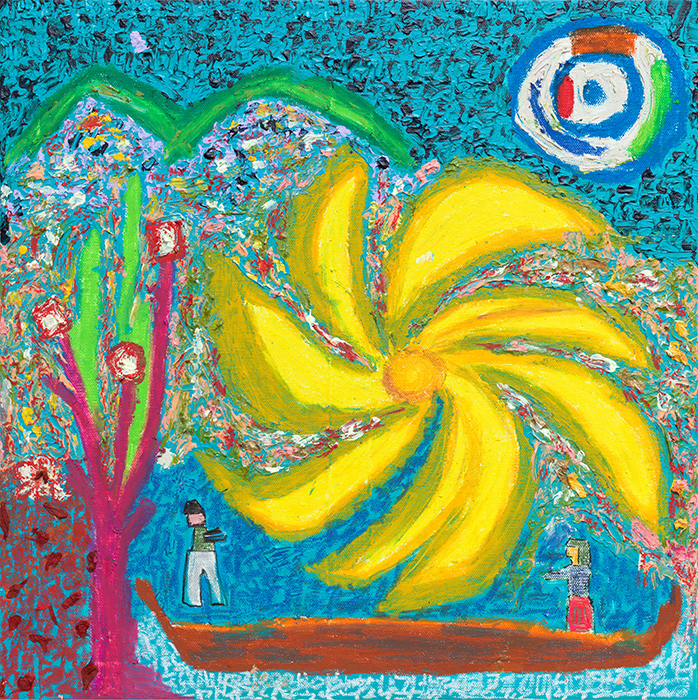
그림일기1.
45x45cm,캔버스에 아크릴,2023

Roland Barthes is exceedingly trivial and
delicate. The reason Barthes, who wished to meet each moment sincerely and
completely, became interested in photography is by no means coincidental.
While looking at a photograph of Napoleon’s youngest brother, Jérôme, the
astonishment Barthes experienced became a lifelong memory. When Barthes viewed
the photograph, he wasn't struck by the emperor in the picture, but by the eyes
that had seen the emperor in person. Barthes was so captivated by this notion
that he wrote a book about it. This book, introduced in Korea under the title
"Camera Lucida," is Barthes' notes on photography.
The photograph, which records something that clearly existed and was clearly
seen, held greater significance for Barthes as a testimony to existence rather
than as a recollection of the past. A photograph freezes a moment that can
never be repeated, showing nothing else but that specific moment. Unlike
paintings, which can feign a reality that never existed, photographs are
irrefutable when they depict what has clearly existed. However, I tore Barthes
apart and reassembled him into a painting.